martes, 14 de abril de 2020

Somos de los mismos: compartimos una historia como especie

Hace aproximadamente 70 mil años en la historia de nuestra especie estuvimos al borde de la extinción, es una historia que se guarda en nuestros registros genéticos y que puso en grandes aprietos a un grupo pequeño de homo sapiens sapiens que tuvieron que ingeniárselas para sobrevivir, pero al parecer como especie resiliente, pues hoy poblamos casi todo el planeta, e incluso algunos humanos pueden encontrarse orbitando sobre él. En la actualidad más bien somos tantos que los recursos, además de desigualmente distribuidos, están siendo explotados y en algunas regiones ya los recursos vitales son escasos.

Esta situación a la que nos enfrentamos actualmente, ante un virus potencialmente contagioso y mortal, es casi repetitivo en nuestra historia, pero no esa de la cual tenemos registro desde hace 12 mil años, sino nuestra historia como especie que lleva en este planeta aproximadamente 200 mil años.

Claro está, que desde hace menos de 10 mil años el desarrollo de la cultura ha sido exponencial, y aunque somos la misma especie, la manera en cómo hemos ido enfrentando el crecimiento demográfico, la forma de aprender y adaptarnos a los entornos culturales, ha transformado de forma articulada nuestra forma de pensar y comportarnos.
Ya no somos 200 sujetos viviendo en tropas, sino que muchas de nuestras relaciones sociales se han convertido en escenarios interactivos donde nos conectamos con cientos e incluso miles de personas, y nuestra capacidad de hacer cálculos sociales a veces nos rebaza los millones de sujetos. Aunque se sabe que podemos manejar esa idea de los miles y millones de personas, hay un límite sobre el cual creamos nuestros vínculos más importantes. De ahí, que no es de extrañarse que constantemente hacemos estos contrastes entre “Nosotros” y los “Otros”, y hasta construimos diferencias donde algunas veces no existen o son culturales, claro diferencias válidas, pero no como para asumir que somos de especies diferentes o de otras razas.

Como especie ya hemos tenido que enfrentarnos a condiciones medioambientales desafiantes y a otras situaciones que han puesto en vilo nuestra supervivencia, y estos han sido actos que hemos tenido que enfrentar como especie social, aquella cuya supervivencia ha sido atribuida a nuestras habilidades sociales y nuestra capacidad de resistir como grupo. Esto no es muy diferente a lo que estamos enfrentando en la actualidad, sin embargo, resulta interesante que, ante esta crisis, el mayor acto de altruismo y empatía que podemos tener por los otros se da con el distanciamiento social y el menor contacto físico que pueda tenerse con los demás.

En este caso, nuestra mayor arma contra esta letal enfermedad sigue siendo nuestro comportamiento social, pero ya no marchamos en conjunto para combatir una situación que no sólo pone en riesgo a nuestra especie, sino que arremete con toda nuestra cultura en general. Claro está que antes de esto ya existía aislamiento social y exclusión para muchos, es para quienes dábamos por hecho nuestra existencia social que la situación nos hace repensar sobre nuestro papel en el planeta y qué acciones deberíamos tomar en adelante.

En algunos casos se ve que hay mucho optimismo por replantear e innovar sobre lo que hacemos, pero también mucha incertidumbre sobre lo que pueda venir, pues no sabemos con exactitud si esto será tomado para bien, transformando nuestro mundo sobre los errores que hemos cometido, o con la idea de volver a la normalidad y recrudecer este modelo de mundo que hemos creado, y sobre tenemos en vilo al planeta.

Hace mucho tiempo hemos dejado de pensar en las generaciones futuras, y hemos volteado nuestra mirada a la inmediatez. Pensar en nuestros hijos o nosotros mismos parece ser lo básico, pero no sobre quienes estarán (si es que estarán) en las siguientes seis u ocho generaciones. Olvidamos pensar hacia atrás, pero también hacía adelante, estamos enfocados en lo que va a pasar los siguientes meses, o añoramos nuestra vida de hace un año.

Creo que una situación como esta debería no sólo unirnos como miembros de la misma especie —cuyas decisiones colectivas pueden cambiar lo que queremos para nuestras generaciones futuras (si es que pensamos en ellas)— pero a su vez, entender que nuestra responsabilidad personal, como individuos autónomos, puede también ejercer un papel importante sobre lo que viene más adelante, sea esto para bien o para mal.

Si después de esta situación, que tiene a casi todo el mundo en el confinamiento seguimos siendo los mismos, será lamentable. Como especie hemos pasado pruebas difíciles, que como hemos visto no son recientes, sino que han sido fundamentales desde nuestra historia temprana como especie.

Seguir siendo los mismos sería trágico y decepcionante, aunque si lo hacemos no es de extrañar, pues hasta el momento hemos elegido líderes como muchos de los que tenemos, y modelos económicos, políticos y sociales que incluso que van en contra de nuestro más entrañable comportamiento social, cooperativo y altruista, e incluso contrarios a nuestra capacidad de ser críticos, autónomos y resilientes.

Tomado de: https://delfino.cr/2020/04/somos-de-los-mismos-compartimos-una-historia-como-especie

lunes, 4 de noviembre de 2019

Lush Okavango Delta Pinpointed as Ancestral Homeland of All Living Humans

Genetic evidence traces our origins to a hunter-gatherer community that lived 200,000 years ago, but the study has generated controversy   

By Richard Conniff on October 28, 2019

Lush Okavango Delta Pinpointed as Ancestral Homeland of All Living Humans
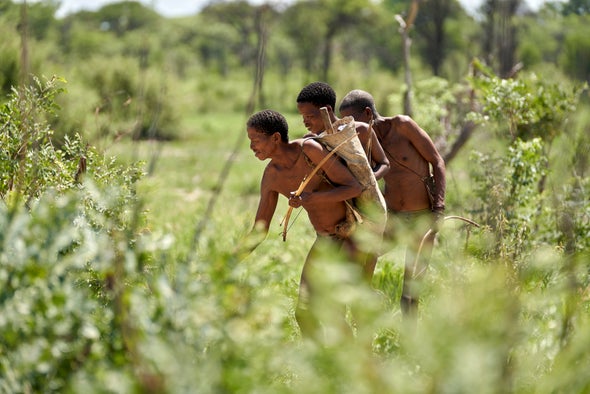
Juǀ’hoansi hunters ǀkun ǀkunta, Nǂamce Sao and ǀkun Nǂamce re-creating how our ancestors hunted when the Homeland was once a vast wetland. ǀkun ǀkunta, Nǂamce Sao and ǀkun Nǂamce today live within the dried Homeland. Credit: Chris Bennett

Anyone lucky enough to have visited the Okavango Delta in the southern African nation of Botswana will recall the comforting and oddly familiar sensation of looking out from the shelter of a stand of trees at the panorama of wildlife—from elephants and African wild dogs to lilac-breasted rollers—moving across the lush surrounding floodplains. That sense of familiarity may run deeper than we imagine, a new study suggests—back to a time when early modern humans also wandered there.

The study, appearing Monday in the journal Nature, uses genetic, archaeological, linguistic and climatic evidence to argue that the ancestral homeland of everyone alive today was in northern Botswana—not in East Africa, as previously thought. Based on mitochondrial DNA, passed down from mother to daughter, the paper’s co-authors argue that we are all descended from a small community of Khoisan hunter-gatherers who lived 200,000 years ago in vast wetlands encompassing Botswana’s Okavango Delta and the Makgadikgadi regions.

Much of that place is now a dry salt pan—and inhabited by modern Khoisan people, sometimes called Bushmen. But back then, it was a vast wetland covering an area the size of Switzerland. The community that lived there was unusually stable, thriving almost unchanged for 70,000 years in a habitat closely resembling the modern Okavango Delta, according to senior author Vanessa M. Hayes, a geneticist at the Garvan Institute of Medical Research in Australia.

The new study looks at the mitogenomes, or mitochondrial genomes, of 1,217 individuals from multiple southern African ethnic identities, and focuses on a “rare deep-rooting” lineage called L0, or L zero. It’s the oldest known mitochondrial lineage, passed down intact from mother to daughter across the generations, though mutations can sometimes occur and may be associated with important evolutionary changes. Hayes became interested in that lineage as a result of her work with the South African Genome Project, which found evidence of L0 ancestry distributed across southern Africa. Archbishop Emeritus Desmond Tutu, descended mainly from Bantu groups who migrated into southern Africa 1,500 years ago, was among those identified as having Khoisan ancestry, a connection he said left him feeling “very privileged and blessed."

Tracking the accumulation of mutations in the L0 lineage across the eons provides geneticists with a time stamp for evolutionary changes. The co-authors of the Nature paper identify and date changes in the L0 lineage. They also correlate these “branching” events with evidence of climatic shifts, as well as with archaeological evidence of human migrations. During the initial 70,000 years of stable habitation, says co-author Axel Timmermann, a climate scientist at Pusan National University in South Korea, migration was probably constrained by harsh, dry conditions in the surrounding landscape. But about 130,000 years ago, a period of increased rainfall opened a green corridor for migrations to the northeast. Then, about 110,000 years ago, drying conditions within the homeland and opening of a green corridor to the southwest led to further migrations down to the southern tip of Africa. Evidence of both events survives, according to the study, in subgroups of the L0 lineage found in living descendants of those migrations.

The new research fits with other recent genetic evidence of human origin in southern Africa, including a study earlier this year suggesting that a migration from that region to East Africa, and the resulting mixture with populations there, might have been a key turning point in the evolution of modern humans and their migration out of Africa. Another paper this year also argues that a migration from southern Africa to East Africa immediately preceded a major out-of-Africa migration 100,000 to 70,000 years ago. The alternative pan-African, or “polycentric,” viewpoint holds that multiple interlinked populations evolved across the continent, sometimes in isolation and sometimes together.

James Cole, an archaeologist at the University of Brighton in England, who was not involved in the new study, praises Hayes and her colleagues for their cross-disciplinary approach to understanding mitochondrial evolution. But he also notes that their paper overlooks major archaeological evidence, such as the 315,000-year-old skeletal remains of an anatomically modern human recently found in Morocco. Hayes replies that her study focuses only on the population of direct ancestors of “people walking around today,” and in the absence of genetic evidence from the Morocco specimens, the connection to living humans is unknown.

Milford Wolpoff, a paleoanthropologist at the University of Michigan who also was not involved in the new work, similarly argues that the evidence its authors present is too narrow. Reliance solely on mitochondrial evidence leads to misinterpretation, he says, and risks overlooking important evolutionary information in the separate DNA of the cell nucleus. Our widespread inheritance of Neandertal genes shows up, for instance, only in the nuclear DNA, and it is completely absent from the mitogenome. Likewise, Wolpoff says, “the nuclear genome, with three billion base pairs, might tell an entirely different story about the African origin of modern humans from what the mitogenome’s 16,000 base pairs” suggest.

“We’re dealing with a puzzle of a million pieces,” Cole says, “and we’ve probably got the first 100 in place.” Paleogenetics has “ramped up the scale of complexity exponentially,” he adds. “From the paleontological and archeological record, it was a 1,000-piece puzzle.” But instead of providing a grand answer to the story of human origin, Cole suggests, so far, genetics is mainly showing us just how complex that story really is.


Okavango Delta Pinpointed as Ancestral Homeland of All Living Humans
Author: Richard Conniff
Publication: Scientific American
Publisher: SCIENTIFIC AMERICAN, a Division of Springer Nature America, Inc.
Date: Oct 28, 2019


lunes, 18 de marzo de 2019

Mind Your “Fs” and “Vs”: Agriculture May Have Shaped Both Human Jaws and Language

Eating porridge and cheese appears to have changed our bite to enable the vocal tract to produce new sounds.
By Anne Pycha on March 14, 2019

Paleolithic flat bite (left) differs from a modern protruding bite (right). Credit: Tímea Bodogán
The organs of speech are the same for all people, or so linguists have typically assumed. But it turns out that may not be true—in fact, what you eat can change how you talk.

The conventional wisdom held in the field of historical linguistics is the vocal apparatus of human beings has remained fixed since the emergence of Homo sapiens some 200,000 years ago. As a consequence, all humans, both ancient and modern peoples, possess the same basic capacity to produce speech sounds. But recent evidence from several studies in paleoanthropology has upended these assumptions by suggesting the way we eat can actually alter jaw anatomy. And according to research just published in Science, the consequences for the way we speak have been profound.

The lead authors of the study, Damián Blasi and Steven Moran of the University of Zurich along with colleagues, became intrigued by fossil evidence showing the form of the human jaw had changed in our species’s relatively recent evolutionary past. Among hunter–gatherers of the Paleolithic period, adults’ upper and lower teeth aligned to form a flat line, the top ones resting directly on the bottom set. Scientists attribute that configuration primarily to tooth wear brought about by chewing hard foods, such as unmilled grains or seeds. With the advent of agriculture in the post-Neolithic period, however, the upper teeth protruded over and above the lower teeth, presumably due to the reduced challenge of consuming soft foods such as porridge and cheese.

These findings suggest not only that the cultural shift that gave rise to agriculture occasioned a shift in human anatomy. It also appears to have introduced new speech sounds known as labiodentals—the “f” and “v,” for instance. Blasi and Moran’s study furnishes evidence that adopting the signature foodstuffs of sedentary society ultimately allowed us to mouth words like “farro” and “verbalize” by raising the lower lip and bringing it into contact with the upper teeth. Their research group conducted biomechanical simulations of this movement using two different virtual jaws to calculate the muscular effort involved. Their results showed, compared with the protruding bites, the flat bite configurations required substantially more effort to produce a labiodental.

Linguists had already established that articulatory effort can affect the fate of a phoneme, so Blasi and Moran’s team speculated that labiodentals would have been less likely to emerge among any population with flat bites, such as Paleolithic humans, or even modern humans who eat harder foods. To test this hypothesis, they analyzed databases of the world’s consonants and showed contemporary hunter–gatherer languages contain only a fraction of the labiodental sounds that food-producer languages do. Of course, food preparation techniques are merely a stand-in for actual bite configurations. To make the link more explicit, the researchers separately analyzed hunter–gatherer societies in Greenland, southern Africa and Australia, where flat bites have been explicitly documented. In line with their hypothesis, results turned up relatively few languages with labiodentals among these populations. When one of these sounds appeared, it was usually borrowed from other languages.

As a final piece of support for their argument, Blasi and Moran’s team examined sound changes in Indo-European languages over time. They used a nontraditional technique called stochastic character mapping, which calculates the numerical probability a sound existed in a language at a particular point in time. Results showed labiodental sounds were extremely unlikely in almost all branches of Indo-European, until anytime from 6,000 to 4,000 years ago. After that period, which coincides with the introduction of soft foods, the probability of these sounds showed a notable increase.

The take-home message: “we can’t take for granted that spoken languages sound the same today as they did in the distant past,” Moran says. “This means in particular that the set of speech sounds we use has not necessarily remained stable since the emergence of our species, but rather the immense diversity of speech sounds that we find today is the product of a complex interplay of factors involving biological change and cultural evolution.”

Not everyone is convinced of the arguments put forth in the new study. Israel Hershkovitz of Tel Aviv University points out many factors besides tooth wear can affect bite configurations. Also, tooth wear occurs gradually and does not fully affect bite dynamics until adulthood. Given the relatively short life expectancy of prehistoric hunter–gatherers, he says, it seems unlikely this anatomical trait could have affected language evolution.

To other observers, Blasi and Moran’s study, along with others in recent years, reflects a paradigm shift in historical linguistics. “This paper revives an idea that linguists probably abandoned out of a natural apprehension—the danger of verging on ideas that could be interpreted as racist—which arises whenever anatomical differences between populations are proposed to play a role in any aspect of language or cognition,” says Andrew Garrett of the University of California, Berkeley, who was not involved in the study. “Today, however, there is clear evidence that individual anatomical, physiological and perceptual differences do play some role in linguistic differences.”

Tomado de: https://www.scientificamerican.com/article/mind-your-fs-and-vs-agriculture-may-have-shaped-both-human-jaws-and-language/?utm_source=newsletter&utm_medium=email&utm_campaign=evolution&utm_content=link&utm_term=2019-03-18_featured-this-week&spMailingID=58765883&spUserID=MjUyMzM5OTAwODkS1&spJobID=1602373337&spReportId=MTYwMjM3MzMzNwS2

lunes, 4 de febrero de 2019

Cave That Housed Neandertals and Denisovans Challenges View of Cultural Evolution

Researchers have deduced which early human species occupied Denisova Cave and when, drawing surprising conclusions about who made the sophisticated artifacts found there

By Kate Wong on January 30, 2019


Deep in the Altai mountains of southern Siberia sits a very choice piece of real estate. It’s nothing so newfangled as a ski lodge or one of the traditional wood houses that dot the local countryside. Rather it’s a primeval limestone cave, called Denisova, that overlooks a rushing river and the surrounding forest. Multiple human species, or hominins, have sought shelter in this cave over the past 300,000 years, such is its allure. Artifacts, bits of bone and ancient DNA found in its chambers testify to the presence of these peoples. The site thus offers a rare window on a particularly fascinating period of human evolution, one in which other human species coexisted with our own kind.

Researchers have long wondered how these groups interacted and influenced one another culturally when they met up, and Denisova could be a key to answering this question. But figuring out which hominin species was present when at the cave and which artifacts they made has proved challenging. Now new efforts to date the remains from Denisova are at last bringing that picture into sharper focus. Two studies published in the January 31 Nature provide a time line of human occupation of the cave. The results raise intriguing questions about the origins of symbolism and certain technologies traditionally considered to be inventions of Homo sapiens alone.

Archaeologists have been unearthing artifacts from Denisova Cave since the 1980s. The site contains frustratingly little in the way of hominin fossils, however. Most of the bones from the site are mere scraps, too incomplete to assign to a particular species on the basis of their physical characteristics. But in the last decade researchers have managed to recover ancient DNA from some of these fossil bits and from sediments in the cave. The DNA shows both Neandertals and another archaic group known as the Denisovans hung out there. And last year a team reported they had retrieved DNA from what was apparently a hybrid individual who had a Neandertal mom and a Denisovan dad. But for all that scientists have been able to piece together about Denisova, the timing of hominin occupation of the site has remained uncertain, thanks to certain quirks of site formation and preservation as well as the limitations of various techniques used to date archaeological and fossil material.


ADVERTISEMENT

In the new studies, two groups of researchers obtained a raft of fresh dates for the stratigraphic levels of interest at the site using a combination of techniques. One group, led by Zenobia Jacobs and Bo Li of the University of Wollongong in Australia, used a method called optically stimulated luminescence to date sediments from the cave. The team also reconstructed the environmental conditions at the site between 300,000 and 20,000 years ago. In the second study, Katerina Douka of the Max Planck Institute for the Science of Human History in Germany, Thomas Higham of the University of Oxford and their colleagues used radiocarbon dating to ascertain the ages of artifacts spanning the transition from the simpler Middle Paleolithic material culture to the more elaborate Upper Paleolithic one. Most of the human fossils are too old for radiocarbon dating, which maxes out at around 50,000 years. So the team determined the so-called relative genetic ages of the human fossils from the site by comparing their DNA sequences with those obtained from other human fossils and counting the differences between them. Such mutations accumulate at a known rate in modern humans. Using that rate the researchers were able to convert the ancient DNA differences to time. Douka, Higham and their colleagues then fed all of the ages obtained from the radiocarbon and optically stimulated luminescence methods, along with timing data from the genetic studies and the stratigraphic layers themselves, into a statistical model that calculated the most probable ages for the human fossils.

The results of these studies reveal Denisovans and Neandertals occupied the cave intermittently from at least 200,000 until around 50,000 years ago during both cooler and warmer climate phases. Denisovans were the first of the two groups to move into the cave and the last to abandon it. They probably overlapped there around 120,000 years ago, and possibly at other times as well.

The time line hints at a tantalizing possibility for who made the early Upper Paleolithic artifacts at the site, which include animal tooth pendants, a stunning stone bracelet and a needle and other tools crafted from bone. The radiocarbon dates obtained from some of the pendants and bone tools put them at 43,000 to 49,000 years old. There are no known hominin remains of that age from the site—the youngest specimen is a Denisovan fossil that dates to between 52,000 and 76,000 years ago. Yet Douka, Higham and their colleagues think creators of these artifacts are likely to have been Denisovans. Neandertals appear to have checked out of the cave by around 80,000 years ago. A fossil from the site of Ust’ Ishim documents the presence of our species in western Siberia around 45,000 years ago, which is the right time for it to be the maker of these artifacts. But that site is hundreds of kilometers from Denisova. “Our Russian colleagues have rightfully argued that we have no modern human fossils at Denisova and no modern human DNA from Denisova sediments, so why invoke modern humans” to explain the onset of the Upper Paleolithic at the site, Douka says. “One might say that given [the Ust’ Ishim fossil], we should assume modern humans made the pendants and bone tools at Denisova, but we don’t have modern human fossils in the Altai at that time.” Higham adds: “It could be modern humans but the most parsimonious explanation for the moment is that it’s Denisovans.”

The suggestion Denisovans developed the Upper Paleolithic artifacts at the site bears on a hot topic in paleoanthropology: the origins of modern behavior and cognition. Once upon a time, archaeologists thought only H. sapiens made symbolic items such as jewelry and advanced technology such as standardized bone tools. Then discoveries in the 1970s ignited debate over whether Neandertals also might have invented such items. In recent years evidence has mounted in support of a more sophisticated Neandertal. For instance, last year researchers reported cave paintings in Spain pre-date the arrival of H. sapiens to the region by thousands of years and must therefore be Neandertals’ handiwork. Neandertals, however, are not the only archaic hominin species to show signs of advanced cognition: In 2015 archaeologists unveiled their discovery of a shell that was engraved with a geometric design some 500,000 years ago—long before the origin of modern humans or Neandertals—the implication being that an earlier human ancestor known from this time period, Homo erectus, must have been the designer.

Could Denisovans have independently developed modern cognitive capabilities, too? Archaeologist Francesco d’Errico of the University of Bordeaux in France, who was not involved in the new studies, contends the paucity of relevant archaeological material from the site and insufficient description of these remains “make it difficult to reach a firm conclusion.” But “I’m not against the idea,” he says. “I do not see why archaic hominins could have not invented personal ornamentation independently and repeatedly, and a lot of evidence from Europe is now supporting this view.”

Pendants made from animal teeth and tools fashioned from bone may have been manufactured by Denisovans. Credit: Katerina Douka

miércoles, 29 de agosto de 2018

When a Neandertal Met a Denisovan, What Happened Was Only Human

Scientists describe the hybrid child of two starkly different human groups

By Richard Conniff on August 22, 2018

In a remarkable twist in the story line of early human evolution, scientists have announced the discovery of “Denisova 11”—a female who was at least 13 years old, lived more than 50,000 years ago and was a child of mixed parentage. Her parents were not just of different races, but two different and now-extinct early human types. Their exact taxonomic designations—whether they were separate species or subspecies—is still a matter of scientific debate. But the bottom line for Denisova 11 is that mom was a Neandertal and dad a Denisovan.

The research, published Wednesday in Nature, is the work of a team led by pioneering paleogeneticist Svante Pääbo at Max Planck Institute for Evolutionary Anthropology in Germany. He and his co-authors published the first description of the Denisovans in 2010, based on genetic evidence from one of the 2,000 or so bone fragments found in Denisova Cave in the Altai Mountains, where Siberia borders Mongolia and China. The new discovery is based on another bone fragment from that lot, a 2.5-centimeter-long fragment of what was a femur or humerus, from which the researchers extracted six DNA samples and then cloned them for detailed analysis.

Molecular dating indicates that Denisovans, who are so far known only from Denisova Cave, and Neandertals, known mainly from sites in Europe, diverged from each other almost 400,000 years ago. They coexisted, probably in relatively small populations scattered across the vast Eurasian landmass, until both became extinct some 30,000 to 40,000 years ago.

But the genetic evidence from Denisova 11 and other recent studies suggests that, on the occasions when they met, Denisovans and Neandertals commonly mated with each other—and with modern humans. Denisova 11’s father carried a small amount of Neandertal ancestry, the study notes, from “possibly as far back as 300 to 600 generations before his lifetime.”

Sharon Browning, a statistical geneticist at the University of Washington who was not involved in the research, praises the new study. “I’m really kind of blown away by it,” she says. “Just to catch the offspring of these two different groups is really remarkable.”

“It looks absolutely solid,” adds University of Utah population geneticist Alan Rogers, who also was not part of the work. “I think these guys, as usual, have done a great job.” Asked if Denisova 11 might have simply been the offspring of a mixed Neandertal–Denisovan population—rather than of a mother and father of two such starkly separate backgrounds—Rogers says, “I felt that their analysis made sense. I was convinced by that. It’s not surprising that the two species would mate, if they were together at the same place and time,” he adds. “But I don’t think we knew before now that they were together at the same place and time—and if they were, it raises the question of why they were so different.” That is, why didn’t they evolve into a single species?

“It’s a really interesting question,” says Harvard University geneticist David Reich, who did not take part in Pääbo’s study. “At Denisova Cave we are clearly looking at an area where these two groups washed across one another, within walking distance of the cave. But there must have been a lot of isolation, as well as mixture.” The hybrid offspring from such divergent populations, Reich says, may have experienced biological problems. Or they may have faced cultural bias, Pääbo notes, if people of mixed backgrounds were “not very well accepted in the cultures of that time.”
Even so, both Neandertals and Denisovans have persisted in the modern human genome. A small percentage of Neandertal ancestry is common in all modern human populations outside Africa; some Denisovan lineage is also common among people from east Asia and Oceania. Earlier this year a study led by Browning indicated the modern Denisovan inheritance derives from at least two separate populations, suggesting they were once dispersed far beyond the Denisova Cave. Pääbo says the next step for his laboratory will be extracting DNA from sediment in the Denisova Cave floors to determine “just when Neandertals were there, when Denisovans were there and when both were there together.”
The dream that scientists could document such interactions in the prehistory of humankind “used to seem impossible,” Reich says. “But now we are getting to witness the dream.”
Tomado de: https://www.scientificamerican.com/article/when-a-neandertal-fell-for-a-denisovan-what-happened-was-only-human/?utm_source=newsletter&utm_medium=email&utm_campaign=evolution&utm_content=link&utm_term=2018-08-27_featured-this-week&spMailingID=57255681&spUserID=MjUyMzM5OTAwODkS1&spJobID=1463668589&spReportId=MTQ2MzY2ODU4OQS2

miércoles, 4 de julio de 2018

¿Cómo cazaban los neandertales?

Unos huesos de hace 120.000 años revelan cómo se hacían los neandertales con sus presas: a dos
gamos los mataron clavándoles lanzas enérgicamente.

Nature Ecology & Evolution

Gracias a los yacimientos se sabe que los neandertales y sus predecesores preparaban lanzas de madera, pero no está claro cómo usaban esas armas: ¿las arrojaban a larga distancia, las clavaban a muy corta distancia o simplemente apartaban con ellas a otros animales de sus botines? Un equipo de investigadores, dirigido por Sabine Gaudzinski-Windheuser, ha encontrado ahora una respuesta. Según las lesiones que han encontrado en unos huesos de gamo de hace 120.000 años, un neandertal arrimado al animal le clavó la lanza y le perforó un agujero en la pelvis. En los de otro gamo han observado lesiones vertebrales que también se causaron con ese mismo tipo de ataque.


La investigadora (del Museo y Centro de Investigaciones Arqueológicas MONREPOS para la Evolución del Comportamiento Humano, en Neuwied, Renania-Palatinado, Alemania) y sus colaboradores lo cuentan en Nature Ecology and Evolution. Los huesos que han investigado se extrajeron en los años ochenta y noventa del siglo pasado junto a un pequeño lago cercano a Halle, en Sajonia-Anhalt, Alemania. Debió de haber allí un espeso bosque en el que presumiblemente los neandertales cazaban al acecho. Las presas estudiadas eran ejemplares de la subespecie hoy extinguida de gamo Dama dama geiselana.

Realizaron pruebas balísticas con los huesos, y de ellas dedujeron que las lesiones se produjeron muy probablemente con un impacto muy potente pero relativamente lento. Si hubiese sido causado por una lanza arrojada cabe suponer que se habrían visto unas señales diferentes.

Hasta ahora se han encontrado muy pocos yacimientos en los que se haya dado con indicios de cómo cazaban los seres humanos de tiempos remotos. La anatomía de los neandertales da a entender que no eran unos lanzadores especialmente hábiles, pero lo observado en los huesos del yacimiento sajón no quiere decir que no usaran nunca sus lanzas como proyectiles; es muy posible que en otras oportunidades sí lo hiciesen.

Jan Dönges / spektrum.de

Artículo traducido y adaptado por Investigación y Ciencia con permiso de Spektrum der Wissenschaft.

Referencia: «Evidence for close-range hunting by last interglacial Neanderthals», de Sabine Gaudzinski-Windheuser et al. en Nature Ecology and Evolution, publicado el 25 de junio de 2018.

Tomado de: 

martes, 13 de junio de 2017

Descubiertos en Marruecos los fósiles más antiguos de la especie humana

Hallazgos recientes hacen retroceder en 100.000 años el origen de Homo sapiens y apuntan a la compleja historia evolutiva de la humanidad, que habría tenido lugar en toda África.

Nature

Reconstrucción del cráneo del Homo sapiens más antiguo conocido hasta ahora, cuyos fósiles se han hallado en Jebel Irhoud (Marruecos). La reconstrucción se ha basado en la microtomografía computarizada de múltiples fósiles originales. Datados de hace 300.000 años, estos humanos ya presentaban un rostro similar al actual. Sin embargo, la morfología de su cavidad craneal (azul) indica que la forma del cerebro, y posiblemente también su función, evolucionaron dentro del propio linaje de Homo sapiens. [© Philipp Gunz, Instituto Max Planck de Antropología Evolutiva / CC-BY-SA 2.0]
Nuevos fósiles y herramientas de piedra descubiertos en el yacimiento arqueológico de Jebel Irhoud, en Marruecos, hacen retroceder los orígenes de nuestra especie unos 100.000 años y demuestran que hace unos 300.000 años tuvieron lugar en una gran parte de África cambios importantes en nuestra biología y comportamiento.

Un equipo internacional de investigadores dirigido por Jean-Jacques Hublin, del Instituto Max Planck de Antropología Evolutiva, en Leipzig, y Abdelouahed Ben-Ncer, del Instituto Nacional de Arqueología y Patrimonio, en Rabat, han descubierto huesos fósiles de Homo sapiens junto con herramientas de piedra y huesos de animales en Jebel Irhoud. Los hallazgos datan de hace unos 300.000 años y constituyen la prueba fósil más antigua de nuestra especie. Son 100.000 años más antiguos que los fósiles considerados hasta ahora los más antiguos de nuestra especie. Los descubrimientos, que se describen en dos artículos recién publicados en Nature, revelan la compleja historia evolutiva de la humanidad, que probablemente sucedió en todo el continente africano.

Los datos genéticos de los humanos actuales y de los restos fósiles apuntan al origen africano de nuestra especie, Homo sapiens. Con anterioridad, los fósiles más antiguos de Homo sapiens, datados de hace 195.000 años, se habían hallado en el yacimiento de Omo Kibish, en Etiopía. En Herto, también en Etiopía, se había descubierto otro fósil de nuestra especie de 160.000 años. Hasta ahora, la mayoría de los investigadores creían, pues, que todos los humanos actuales descendíamos de una población que vivió en el este de África hace unos 200.000 años, pero los nuevos datos revelan que Homo sapiens ya se había extendido antes por todo el continente africano, hace unos 300.000 años. «Mucho antes de su dispersión fuera de África, se produjo una dispersión dentro del continente», comenta Hublin.

El yacimiento de Jebel Irhoud era conocido desde la década de 1960 por sus fósiles humanos y sus artefactos de la Edad de Piedra Media. Sin embargo, la interpretación de los restos de los homininos había resultado complicada desde hacía tiempo por las persistentes incertidumbres que rodeaban su antigüedad. La nueva excavación, que comenzó en 2004, reveló nuevos fósiles de Homo sapiens, que aumentaron de seis a 22. Los restos corresponden a cráneos, dientes y huesos largos de al menos cinco individuos. Para establecer su cronología, los investigadores utilizaron el método de datación por termoluminiscencia de piedras talladas calentadas con fuego halladas en los mismos depósitos, lo que arrojó una antigüedadad de unos 300.000 años. También emplearon métodos mejorados de resonancia de espín electrónico para la datación de los fósiles y obtuvieron datos concordantes con esa edad.

Los cráneos de los humanos actuales se caracterizan por una combinación de rasgos que nos diferencian de otras epecies emperentadas con la nuestra: un rostro pequeño y grácil y una cavidad craneal globular. Los fósiles de Jebel Irhoud exhiben un rostro y dientes similares a los actuales, y también presentan una gran cavidad craneal, aunque de aspecto más arcaico. Hublin y su equipo utilizaron la novedosa técnica de microtomografía computarizada y análisis estadísticos para demostrar que la forma de la cara de los ejemplares de Jebel Irhoud resultaba casi indistinguible de la de los humanos actuales. «La forma interior de la cavidad craneal refleja la forma del cerebro», explica Philipp Gunz, del Instituto Max Planck de Antropología Evolutiva. «Nuestros hallazgos sugieren que la actual morfología facial de los humanos surgió al inicio de la historia evolutiva de nuestra especie, y que la forma del cerebro, y posiblemente también las funciones cerebrales, evolucionaron dentro del linaje de Homo sapiens», dice Gunz.

La morfología y la edad de los fósiles de Jebel Irhoud también corroboran la interpretación de un enigmático cráneo parcial hallado en Florisbad, en Sudáfrica, que se había atribuido a un representante primitivo de nuestra especie. Los fósiles más antiguos de Homo sapiens se han encontrado, pues, en todo el continente africano: Jebel Irhoud, Marruecos (300.000 años), Florisbad, Sudáfrica (260.000 años) y Omo Kibish, Etiopía (195.000 años). Ello indica la compleja historia evolutiva de nuestra especie, que tuvo lugar en todo el continente africano.

«El norte de África no se había tenido en cuenta desde hace mucho tiempo en los debates acerca del origen de nuestra especie. Ahora, los descubrimientos espectaculares de Jebel Irhoud demuestran las estrechas conexiones del Magreb con el resto del continente africano en el momento de la aparición de Homo sapiens», comenta Ben-Ncer.

Más información en Nature (1) y (2)

Fuente: Instituto Max Planck de Antropología Evolutiva

jueves, 15 de diciembre de 2016

Un componente de la leche materna facilita el aprendizaje y la memoria


Un componente de la leche materna facilita el aprendizaje y la memoria

Investigadores de la Universidad Pablo de Olavide (UPO) de Sevilla, en colaboración con otros científicos de la multinacional Abbott ubicados en Granada y en Columbus (Estados Unidos), son pioneros en el estudio de los efectos específicos de determinados componentes de la leche materna sobre el desarrollo de diversas funciones cerebrales y cognitivas.    En un reciente estudio experimental y preclínico, publicado en la prestigiosa revista PLOS ONE, estos investigadores han mostrado qu ...


(c) 2015 Europa Press. Está expresamente prohibida la redistribución y la redifusión de este contenido sin su previo y expreso consentimiento.

miércoles, 19 de octubre de 2016

Monos brasileños afilan las piedras a golpes como los humanos

Los hombres y mujeres de la Edad de Piedra golpeaban piedras para crear armas y herramientas con las que cortaban y raspaban gracias a las lascas que se desprendían del núcleo. Hasta ahora, se pensaba que éramos los únicos animales en hacerlo. Pero un equipo de científicos ha descubierto que unos monos capuchinos salvajes de Brasil también rompen rocas. En su caso, lo hacen para extraer minerales o líquenes de ellas.


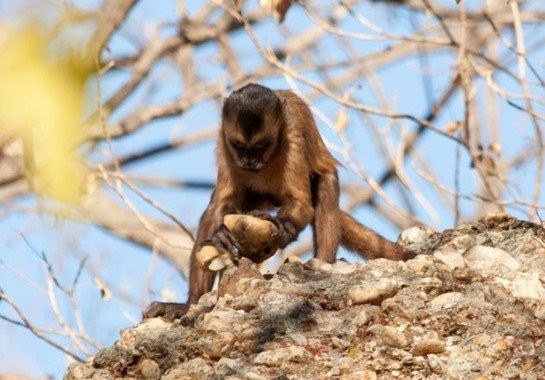
Los monos silbadores (Sapajus libidinosus) golpean la piedra una y otra vez, como si fuera un martillo, y la percusión continuada hace que se formen afiladas láminas de piedras, llamadas lascas, como las que formaban los humanos de la Edad de Piedra para hacer sus armas o herramientas. Hasta ahora, los científicos pensaban que crear este tipo de fracturas en la roca era un comportamiento único en humanos.

El estudio, publicado en Nature, demuestra que, al igual que los humanos, estos pequeños capuchinos de Brasil también son capaces de fabricar, aunque de manera inintencionada, herramientas de piedra. A pesar de romperlas de forma deliberada, su objetivo es extraer minerales o líquenes de las piedras, según los científicos que los observaron en el Parque Nacional de Serra da Capivara en Brasil.

El equipo admite que sigue sin quedar del todo claro por qué llevan a cabo este comportamiento. En ningún momento los monos intentaron cortar o raspar con las lascas, sino más bien parecían querer extraer el polvo de silicio de las rocas o los líquenes con propósitos medicinales. “En la última década, diversos estudios han demostrado que el uso y la producción intencionada de láminas afiladas no están necesariamente vinculados a los primeros seres humanos, al género Homo, que son nuestros parientes directos, sino que también fueron utilizadas y producidas por un rango más amplio de homínidos”, explica Tomos Proffitt, investigador principal del trabajo y científico en la Escuela de Arqueología de la Universidad de Oxford (Reino Unido).

Estos pequeños capuchinos también fabrican, aunque de manera inintencionada, herramientas de piedra.

Un mono silbador machaca una piedra. Imagen: T. V. Falótico

Para el equipo de investigación, este trabajo va un paso más porque muestra que los primates modernos pueden producir lascas y núcleos arqueológicamente identificables con las características que se pensaban que eran exclusivas de los homínidos.

“Esto no quiere decir que el material arqueológico más antiguo en África oriental no lo hicieran los homínidos. Sin embargo, el hallazgo plantea cuestiones interesantes sobre cómo se desarrolló esta tecnología de herramientas de piedra antes de que aparecieran los primeros ejemplos en el registro arqueológico”, señala Proffitt, para quien este descubrimiento desafía las ideas anteriores sobre el nivel mínimo de complejidad cognitiva y morfológica necesario para producir numerosas lascas concoides.

Herramientas de piedra hechas por monos

Según las observaciones de los científicos, los monos silbadores seleccionan de forma individual cantos de cuarcita redondeada, y usando una o las dos manos golpean enérgica y repetidamente la piedra como si fuera un martillo contra otras rocas situadas en un acantilado.

Escogen cantos de cuarcita redondeada y los golpean enérgicamente contra otras rocas como si fueran martillos


Esta acción hace que la superficie de la piedra sobre la que se golpea se aplaste, y la que sostiene la mano se rompe, dejando un registro arqueológico identificable de estos primates. Estos capuchinos también fueron observados reutilizando piedras usadas como martillos que se habían roto anteriormente.

En total, los científicos examinaron 111 fragmentos de piedras recogidos del suelo inmediatamente después de caerse, y de la superficie y de la zona excavada. Los investigadores también recogieron las piedras completas o rotas con las que y sobre las que golpearon, y las lascas completas o fracturadas.

Cerca de la mitad de las lascas mostraban fracturas concoidales (con forma curva), asociadas con la producción de lascas por parte de los homínidos. Aunque otros monos capuchinos y macacos japoneses son conocidos por golpear piedras las unas contra las otras, el estudio subraya que los monos silbadores de Brasil son los únicos primates salvajes con la intención de romper las piedras.

“El hecho de que hayamos descubierto monos que sean capaces de crear herramientas a partir de piedras afiladas nos hace pensar sobre la evolución del comportamiento y sobre cómo atribuimos la autoría de los artefactos”, dice Michael Haslam, coautor del estudio y líder del proyecto Primate Archaeology (Primarch) de la universidad británica.

Sin embargo, mientras el hallazgo revela que los humanos no son los únicos en crear esta tecnología, “la manera en la que la usan parece seguir siendo muy diferente a la de los monos”, concluye el científico.

Referencia bibliográfica:

Tomos Proffitt et al. “Wild monkeys flake stone tools" Nature 19 de octubre de 2016 

Tomado de: http://www.agenciasinc.es/Noticias/Monos-brasilenos-afilan-las-piedras-a-golpes-como-los-humanos

Monos brasileños afilan las piedras a golpes como los humanos

Los hombres y mujeres de la Edad de Piedra golpeaban piedras para crear armas y herramientas con las que cortaban y raspaban gracias a las lascas que se desprendían del núcleo. Hasta ahora, se pensaba que éramos los únicos animales en hacerlo. Pero un equipo de científicos ha descubierto que unos monos capuchinos salvajes de Brasil también rompen rocas. En su caso, lo hacen para extraer minerales o líquenes de ellas.


Los monos silbadores (Sapajus libidinosus) golpean la piedra una y otra vez, como si fuera un martillo, y la percusión continuada hace que se formen afiladas láminas de piedras, llamadas lascas, como las que formaban los humanos de la Edad de Piedra para hacer sus armas o herramientas. Hasta ahora, los científicos pensaban que crear este tipo de fracturas en la roca era un comportamiento único en humanos.

El estudio, publicado en Nature, demuestra que, al igual que los humanos, estos pequeños capuchinos de Brasil también son capaces de fabricar, aunque de manera inintencionada, herramientas de piedra. A pesar de romperlas de forma deliberada, su objetivo es extraer minerales o líquenes de las piedras, según los científicos que los observaron en el Parque Nacional de Serra da Capivara en Brasil.

El equipo admite que sigue sin quedar del todo claro por qué llevan a cabo este comportamiento. En ningún momento los monos intentaron cortar o raspar con las lascas, sino más bien parecían querer extraer el polvo de silicio de las rocas o los líquenes con propósitos medicinales. “En la última década, diversos estudios han demostrado que el uso y la producción intencionada de láminas afiladas no están necesariamente vinculados a los primeros seres humanos, al género Homo, que son nuestros parientes directos, sino que también fueron utilizadas y producidas por un rango más amplio de homínidos”, explica Tomos Proffitt, investigador principal del trabajo y científico en la Escuela de Arqueología de la Universidad de Oxford (Reino Unido).

Estos pequeños capuchinos también fabrican, aunque de manera inintencionada, herramientas de piedra.

Un mono silbador machaca una piedra. Imagen: T. V. Falótico

Para el equipo de investigación, este trabajo va un paso más porque muestra que los primates modernos pueden producir lascas y núcleos arqueológicamente identificables con las características que se pensaban que eran exclusivas de los homínidos.

“Esto no quiere decir que el material arqueológico más antiguo en África oriental no lo hicieran los homínidos. Sin embargo, el hallazgo plantea cuestiones interesantes sobre cómo se desarrolló esta tecnología de herramientas de piedra antes de que aparecieran los primeros ejemplos en el registro arqueológico”, señala Proffitt, para quien este descubrimiento desafía las ideas anteriores sobre el nivel mínimo de complejidad cognitiva y morfológica necesario para producir numerosas lascas concoides.

Herramientas de piedra hechas por monos

Según las observaciones de los científicos, los monos silbadores seleccionan de forma individual cantos de cuarcita redondeada, y usando una o las dos manos golpean enérgica y repetidamente la piedra como si fuera un martillo contra otras rocas situadas en un acantilado.

Escogen cantos de cuarcita redondeada y los golpean enérgicamente contra otras rocas como si fueran martillos


Esta acción hace que la superficie de la piedra sobre la que se golpea se aplaste, y la que sostiene la mano se rompe, dejando un registro arqueológico identificable de estos primates. Estos capuchinos también fueron observados reutilizando piedras usadas como martillos que se habían roto anteriormente.

En total, los científicos examinaron 111 fragmentos de piedras recogidos del suelo inmediatamente después de caerse, y de la superficie y de la zona excavada. Los investigadores también recogieron las piedras completas o rotas con las que y sobre las que golpearon, y las lascas completas o fracturadas.

Cerca de la mitad de las lascas mostraban fracturas concoidales (con forma curva), asociadas con la producción de lascas por parte de los homínidos. Aunque otros monos capuchinos y macacos japoneses son conocidos por golpear piedras las unas contra las otras, el estudio subraya que los monos silbadores de Brasil son los únicos primates salvajes con la intención de romper las piedras.

“El hecho de que hayamos descubierto monos que sean capaces de crear herramientas a partir de piedras afiladas nos hace pensar sobre la evolución del comportamiento y sobre cómo atribuimos la autoría de los artefactos”, dice Michael Haslam, coautor del estudio y líder del proyecto Primate Archaeology (Primarch) de la universidad británica.

Sin embargo, mientras el hallazgo revela que los humanos no son los únicos en crear esta tecnología, “la manera en la que la usan parece seguir siendo muy diferente a la de los monos”, concluye el científico.

Referencia bibliográfica:

Tomos Proffitt et al. “Wild monkeys flake stone tools" Nature 19 de octubre de 2016 

Tomado de: http://www.agenciasinc.es/Noticias/Monos-brasilenos-afilan-las-piedras-a-golpes-como-los-humanos

lunes, 29 de agosto de 2016

Early Hominid Lucy May Have Died by Falling out of a Tree


Scientists printed out 3-D models of Lucy's bones, showing a breakage pattern consistent with a fall from a tree.

This video was reproduced with permission and was first published on August 29, 2016. It is a Nature Video production.

Tomado de: http://www.scientificamerican.com/video/early-hominid-lucy-may-have-died-by-falling-out-of-a-tree/

Like Humans, Chimps Reward Cooperation and Punish Freeloaders

Recent research challenges the notion that our closest animal relatives don’t like working as a team.
Three chimpanzees pull at the cooperation apparatus, with two others looking on. Credit: Image courtesy of Frans de Waal, Yerkes National Primate Research Center

Although humans love the playful ways and toothy grins of chimpanzees, our primate cousins have the reputation of being competitive, churlish and, at times, aggressive.

New research published today in Proceedings of the National Academy of Sciences suggests that despite being prone to occasional violent behavior, chimps actually much prefer cooperating over competing. In fact, the work shows that chimps work together at similar rates as humans—and that when violence does occur among apes, it is often directed toward an individual that is not being a team player.

Working with 11 chimps housed in a large outdoor enclosure at the Yerkes National Primate Research Center at Emory University, researchers devised an experiment to assess cooperation, defined as two or more chimps working together to access a food reward. Initially two chimps had to team up, with one lifting a barrier and the other pulling in a tray baited with small pieces of fruit. Once cooperation between two subjects was established, another barrier was added, requiring a third chimp to pitch in if all three were to obtain the spoils.

Given that the apes had nearly 100 hours to obtain their reward in the presence of bystander chimps, there were plenty of chances for competition to arise. The authors defined “competition” as episodes of physical aggression, bullying a fellow chimp to leave the scene of the reward or freeloading—stealing the prizes of others without putting in the work of retrieving them.

Although the study only looked at a small number of individuals, the results were telling. In 94 hour-long test sessions, the chimps cooperated with one another 3,565 times—five times more often than they were in competition. In addition, the animals used a variety of strategies to punish competitive behaviors, such as preferentially working with their more communal and tolerant fellow animals.
When aggression did occur, it was often used to subdue the overly competitive or prevent freeloading, perhaps an even greater affront to the chimpanzee honor code. Attempted thefts by those who did not put in the work were not well received. In fact, the researchers even observed 14 instances in which a third-party chimp—typically one of the more dominant of the bunch— intervened to punish freeloaders. “It has become a popular claim in the [scientific] literature that human cooperation is unique,” study co-author Frans de Waal, a primatologist at Yerkes, said in a statement. “Our study is the first to show that our closest relatives know very well how to discourage competition and freeloading.”

Plenty of other species exhibit cooperative behaviors—take for example the enviable coordination of ants building a subterranean metropolis. But as lead author and Canisius College psychologist Malini Suchak explains, what her team observed in chimps is even more impressive. “Although cooperation is widespread across species, cooperation in ants, for example, as well as in many other species is directed toward kin and is basically preprogrammed,” she says. “Our study shows that chimpanzees are really thinking about cooperation and actively making decisions that maximize cooperation and minimize competition.” She adds: “Cognitively, what they did in our experiment is much closer to what humans do when we cooperate than it is to what ants do when they cooperate.”

Michael Tomasello of the Max Planck Institute for Evolutionary Anthropology, a pioneer in this area of research who was not involved in the study, pointed out in an e-mail that the new work does have limitations beyond just its small size. Tomasello’s past work has shown that when given the option to work together to obtain food versus working solo, chimpanzees actually prefer to go it alone, a trait that distinguishes them from humans. The chimps in Suchak’s study were free to roam their Yerkes enclosure and had access to their usual “primate chow,” but in the wild they may have chosen to freely forage by themselves instead of cooperating to obtain food, Tomasello believes.

Still, mounting evidence supports the notion that other primates are perhaps more like us than previously thought. Earlier work by Suchak, de Waal and colleagues published in 2014 found that chimpanzees living in socially rich and complex settings spontaneously joined forces with their roommates. Beyond apes, last month Scientific American reported on research showing that monkeys, like humans, become more socially selective with age, preferring to spend time with their “friends” over other monkeys.

Unfortunately, great apes may share our more concerning qualities as well: Chimpanzees in nature will frequently form alliances with one another so they can compete more effectively against others. Field work in Uganda by University of Michigan anthropologist John Mitani found that every few weeks the males in a particular chimp community assemble single-file and carefully scope out neighboring territories. If not outnumbered, the trespassers will stage a siege in hopes of winning new territory.

Collaborative chimps, cranky old monkeys, mass conflict—in our simian relatives we increasingly see a reflection of ourselves. As Suchak points out, her new findings imply that the origins of our cooperative behaviors—those rooted in developed senses of tolerance and trust and, at times, reward through coordinated violence—may go farther back than previously thought. “In the past, chimpanzees have been characterized as overly aggressive and competitive, which resulted in people suggesting human cooperative behavior evolved relatively recently and is somehow distinct from cooperation observed in other species,” she says. “Our findings are a reminder that humans are animals, after all.”

Tomado de: http://www.scientificamerican.com/article/like-humans-chimps-reward-cooperation-and-punish-freeloaders/?WT.mc_id=SA_SP_20160829

lunes, 8 de agosto de 2016

Humanity’s forgotten family

Hominin fossils discovered near the site of the ‘hobbit’ Homo floresiensis provide yet more evidence that the human lineage is more diverse than was ever imagined.

Arthur C. Clarke wrote in 2001: A Space Odyssey that behind every person now living stand 30 ghosts, for that is by how many the dead outnumber the living. That was in 1968 — the number reckoned today would probably be greater. The human lineage diverged from that of chimpanzees some 5 million to 7 million years ago. Were we able to mark the remains of all our ancestors from that point, the world would be one enormous cemetery.

The most likely fate of any living organism is dissociation into its component molecules, if not reabsorption as food into something else. That makes the chance ineffably remote that the remains of any one individual will be fossilized in any recognizable form, and, this having been achieved, be recognized as such by a passing palaeontologist before the fossil, too, crumbles to dust.

It is possible that many human species once existed, but became extinct with such finality that even those few that were fossilized have since disappeared, leaving absolutely no trace that generations of a distinct species lived and died on this planet — a kind of double extinction, without hope of memorial or discovery. Fossils from the human lineage are scarce, and, given the numbers that must once have lived, the percentage recovered must hardly be significantly different from zero. (You can read about some of those that have been found in our Nature collection at go.nature.com/1zjssjs.)

Long-lost relations
Hence the surprise when, in 2004, a group of scientists in Indonesia and Australia announced the discovery of what became known as Homo floresiensis, a species of unusual, dwarfed hominin — that is, a creature living or extinct more closely related to us than to chimps — whose remains were found in Liang Bua cave on the island of Flores in Indonesia (P. Brown et al. Nature 431, 1055–1061; 2004).

There was some doubt at the time that H. floresiensis represented a real species rather than a variant of modern humans affected by some disease or pathological condition, but this dissent was gradually eroded, not only by a long palaeontological record at Liang Bua, but also by a rich archaeological record in the island’s Soa Basin, some distance to the east, showing that hominins of some sort had lived in the region for up to one million years (A. Brumm et al. Nature 464, 748–752; 2010). Yet direct evidence, in the form of bones and teeth, was elusive. Until now.

In this week’s issue, researchers report a fragment of mandible and six isolated teeth of hominins from Mata Menge in the Soa Basin that they describe as similar to those of H. floresiensis, but more primitive in some respects and — if anything — even smaller. In an accompanying paper, they show that the remains were deposited 700,000 years ago, many thousands of years before those from Liang Bua.

The researchers take the appropriately cautious and parsimonious view that these hominins were most closely related to early Asian Homo erectus, on the grounds that this is the only species of hominin otherwise known to have inhabited that part of the world at that time. However, it remains possible, as an accompanying News & Views explains, that these creatures might represent some very early, pre-H. erectus exodus from Africa. If so, that expands our ignorance from a barely manageable ocean into a gulf of inter­stellar magnitude, implying that a wholly unknown plethora of hominins lived in Eurasia millions of years earlier than anyone suspected, just one of whose number has been found in the region’s southeastern extremity to betray the possibility that such an array of species ever existed.

Is this unwarranted speculation? Perhaps not: the discovery of H. floresiensis prompted a sea change in palaeoanthropologists’ attitudes to the unknown. Researchers are less eager than they once were to string fossils together into confident chains of ancestry and descent. They are more likely to reappraise the various oddities of human evolution, no longer dismissing them as fossils that are hard to fit into the current paradigm of ancestry and descent, but seeing them as representatives of entirely unsuspected branches of the human family tree. One thinks of the many hominin remains recovered over the past few decades from China, some of which do not quite fit into any current species. Or of Homo heidelbergensis, an increasingly unwieldy catch-all for hominins from the Middle Pleistocene epoch (781,000–126,000 years ago); or of H. erectus itself, a grouping of such variety that some have found it hard to accept that all the fossils ascribed to it comprise a single species. And there are others less familiar, such as skulls from Iwo Eleru in Nigeria that look surprisingly archaic, despite being assigned a relatively recent date of as few as 11,700 years ago (K. Harvati et al. PLoS ONE 6, e24024; 2011).

Studies on human DNA, ancient and modern, have reinforced this trend. The recovery of an entire genome of a hitherto unknown archaic hominin from a single finger bone from Denisova Cave in Siberia was — and is — an astonishing achievement, both for the discovery itself and for its implications (D. Reich et al. Nature 468, 1053–1060; 2010). It reinforces hints that the scarcity of human fossils belies what might once have been hitherto unimaginable diversity. The finding, reported in the same paper, that Denisovan DNA lives on in people from southeast Asia and the western Pacific, just as Neanderthal DNA survives in Eurasians generally, proves that fossils tell us much less than we would like of the human career. And as with Iwo Eleru, so with DNA: there are signs that the genomes of some modern Africans contain elements derived from archaic hominins not found in the fossil record (M. F. Hammer et al. Proc. Natl Acad. Sci. USA 108, 15123–15128; 2011).

These early human relatives left signs of their passing as evanescent and enigmatic as the Cheshire Cat from Alice’s Adventures in Wonderland — slowly fading from view, with just its smile hanging on, until that, too, disappears.

Nature 534, 151 (09 June 2016) doi:10.1038/534151a

miércoles, 20 de julio de 2016

Información ancestral en el cerebro

La geometría de la superficie cortical humana contiene abundante información ancestral. En concreto, las circunvalaciones y los surcos de la corteza cerebral son las estructuras que aportan más datos. Investigadores de la Universidad de California en San Diego compararon las segmentaciones superficiales, los giros y surcos del cerebro de más de 500 jóvenes con su herencia genética.

Hallaron que los sujetos cuyos antepasados procedían de poblaciones primitivas norteamericanas presentaban curvaturas frontales y occipitales aplanadas. Los patrones anatómicos del cerebro de otros participantes situaban sus raíces en África Occidental, Asia Oriental o Europa.

Las imágenes muestran los prototipos corticales que Chun Chieh Fan y sus colaboradores determinaron para los linajes genéticos de estas cuatro partes del mundo. Las líneas de colores indican el contorno tridimensional de la corteza cerebral de los diferentes grupos de población, además de representar la dimensión espacial (longitudinal, sagital o transversal) hacia la que se han desplazado los vértices de los respectivos repliegues.

Los autores no encontraron ninguna relación entre la forma del cerebro de los probandos y sus respectivas capacidades cognitivas. En otras palabras, la geometría cerebral no tiene nada que ver con la inteligencia.


Fuente: «Modeling the 3D geometry of the cortical surface with genetic ancestry­». C. Fun et al., en Current Biology, vol. 25, n.o 15, págs. 1988-1992, 2015

miércoles, 29 de junio de 2016

‘Hobbit’ relatives found after ten-year hunt

Jaw and teeth discovered in Indonesia are triumph for team that almost gave up hope.

Ewen Callaway


More than a decade after the discovery that a diminutive relative of modern humans once lived on the Indonesian island of Flores, Gerrit van den Bergh was losing faith that he would find any clues to the ancestors of the ‘hobbit’. It was October 2014, and for four years he had co-led an industrial-scale excavation near the cave where the metre-tall skeleton had been found. Then, weeks before packing it in for the year, a local worker found a 700,000-year-old molar. More teeth and a partial jaw quickly followed.

“We had given up hope we would find anything, then it was ‘bingo!’,” says van den Bergh, a palaeontologist at the University of Wollongong, Australia, whose team reports the finds in two papers in this issue (G. D. van den Bergh et al. Nature 534, 245–248; 2016; and A. Brumm et al. Nature 534, 249–253; 2016). “We had this enormous party. We had a cow slaughter and there was dancing. It was marvellous.”

The unusually petite jaw and teeth are from at least one adult and two children — the first possible ancestors of Homo floresiensis ever to be discovered — and resemble the hobbit remains found on the island, which are between 60,000 and 100,000 years old.

The jaw and teeth address two questions that have dogged the study of the species — where did it come from and how did it get so small? But as with all things hobbit, there is little consensus among researchers, who say that firm conclusions require more fossils.

The hobbit’s discovery in 2003 in Liang Bua cave, by a team led by the late Australia-based rock-art specialist Mike Morwood, was an instant sensation. But its place in the human family tree is contentious. Morwood’s team proposed that it was a shrunken Homo erectus, the same species that probably evolved into Homo sapiens in Africa and that roamed as far as Europe and Asia. Other scientists who have examined features of H. floresiensis, such as its long, flat feet, think that it descended from a smaller, more primitive human relative such as Homo habilis or even Australopithecus, known only from remains in sub-Saharan Africa.

The late rock-art specialist Mike Morwood at Liang Bua cave, where his team discovered Homo floresiensis.
Seeking the hobbit’s ancestors, in 2004, Morwood’s team returned to a site 74 kilometres from Liang Bua called Mata Menge, where elephant bones and tools had been found in the 1960s. The dig started small, but in 2010 the team scaled up. Bulldozers cleared an area of 2,000 metres square, and more than 100 locals then dug for 6 days a week using chisels and hammers. They found hundreds of stone tools, thousands of fossils from animals such as crocodiles, rats and komodo dragons, but no hominin bones.

By then ill with advanced prostate cancer, Morwood visited the area for the last time in 2012. “He really made an effort to walk through the site, you could see he was in pain, but he was so detailed-minded,” van den Bergh says. “He increased the pressure to dig more holes and go faster. He really wanted to find them.”

Morwood, who died in 2013 before the teeth and jawbone were found, is an author on the Nature papers, which were co-led by scientists based in Japan, Australia and Indonesia.

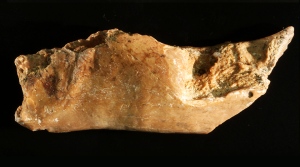
G. D. van den Bergh et al.The jaw bone found on Flores is from an adult who was even smaller than the hobbit.
The team concludes that the jaw excavated at Mata Menge is from an adult (its wisdom tooth had erupted) who was even smaller than the hobbit, and that two canines are the milk teeth of two different children. The thin jaw looks more like that of H. erectus and H. floresiensis than the beefier jaws of more primitive hominins such as H. habilis. The square-shaped teeth are intermediate between H. erectus and H. floresiensis. One tooth and the rock around it led the team to estimate that the remains are some 700,000 years old. The oldest artefacts in the region, meanwhile, suggest that a group of Homo erectus arrived on Flores about one million years ago, says van den Bergh.

Dwarfed by diet

He and his team note that the remains point to large-bodied H. erectus as the likeliest ancestor of the hobbit, and propose that it became dwarfed in just a few hundred thousand years to cope with the meagre resources on Flores. Elephants and other large creatures have been known to shrink over time to cope with the lack of food typical of islands, and red deer on the island of Jersey in the English Channel became one-sixth of their original size in just 6,000 years, says van den Bergh.

G. D. van den Bergh et al.Teeth found at the Mata Menge site

Both Fred Spoor, a palaeontologist at University College London, and palaeoanthropologist Chris Stringer at London’s Natural History Museum agree that H. erectus is now the best fit for the hobbit’s ancestor, although Stringer isn’t so sure that the shrinkage happened on Flores. It’s just as likely that the hobbit emerged on another island, such as Sulawesi, and then moved to Flores, he says.

But William Jungers, a palaeoanthropologist at Stony Brook University in New York, says that the fossils are not complete enough to favour the H. erectus origin: “I don’t believe these scrappy new dental specimens inform the competing hypotheses for the origin of the species one way or another.”

A small river that leads down a hill deposited the sandstone in which the teeth and jaw were found, and van den Bergh expects that more hominin remains lie there. His colleagues, meanwhile, have found stone tools in Sulawesi, north of Flores. For once, the prospect of more hobbits isn’t looking so bleak.

Nature 534, 164–165 (09 June 2016) doi:10.1038/534164a

Tomado de: http://www.nature.com/news/hobbit-relatives-found-after-ten-year-hunt-1.20045?WT.ec_id=NEWS-20160609&spMailingID=51569420&spUserID=NDE2OTkzMjMwMjMS1&spJobID=941259260&spReportId=OTQxMjU5MjYwS0