miércoles, 20 de julio de 2016

Información ancestral en el cerebro

La geometría de la superficie cortical humana contiene abundante información ancestral. En concreto, las circunvalaciones y los surcos de la corteza cerebral son las estructuras que aportan más datos. Investigadores de la Universidad de California en San Diego compararon las segmentaciones superficiales, los giros y surcos del cerebro de más de 500 jóvenes con su herencia genética.

Hallaron que los sujetos cuyos antepasados procedían de poblaciones primitivas norteamericanas presentaban curvaturas frontales y occipitales aplanadas. Los patrones anatómicos del cerebro de otros participantes situaban sus raíces en África Occidental, Asia Oriental o Europa.

Las imágenes muestran los prototipos corticales que Chun Chieh Fan y sus colaboradores determinaron para los linajes genéticos de estas cuatro partes del mundo. Las líneas de colores indican el contorno tridimensional de la corteza cerebral de los diferentes grupos de población, además de representar la dimensión espacial (longitudinal, sagital o transversal) hacia la que se han desplazado los vértices de los respectivos repliegues.

Los autores no encontraron ninguna relación entre la forma del cerebro de los probandos y sus respectivas capacidades cognitivas. En otras palabras, la geometría cerebral no tiene nada que ver con la inteligencia.


Fuente: «Modeling the 3D geometry of the cortical surface with genetic ancestry­». C. Fun et al., en Current Biology, vol. 25, n.o 15, págs. 1988-1992, 2015

miércoles, 29 de junio de 2016

‘Hobbit’ relatives found after ten-year hunt

Jaw and teeth discovered in Indonesia are triumph for team that almost gave up hope.

Ewen Callaway


More than a decade after the discovery that a diminutive relative of modern humans once lived on the Indonesian island of Flores, Gerrit van den Bergh was losing faith that he would find any clues to the ancestors of the ‘hobbit’. It was October 2014, and for four years he had co-led an industrial-scale excavation near the cave where the metre-tall skeleton had been found. Then, weeks before packing it in for the year, a local worker found a 700,000-year-old molar. More teeth and a partial jaw quickly followed.

“We had given up hope we would find anything, then it was ‘bingo!’,” says van den Bergh, a palaeontologist at the University of Wollongong, Australia, whose team reports the finds in two papers in this issue (G. D. van den Bergh et al. Nature 534, 245–248; 2016; and A. Brumm et al. Nature 534, 249–253; 2016). “We had this enormous party. We had a cow slaughter and there was dancing. It was marvellous.”

The unusually petite jaw and teeth are from at least one adult and two children — the first possible ancestors of Homo floresiensis ever to be discovered — and resemble the hobbit remains found on the island, which are between 60,000 and 100,000 years old.

The jaw and teeth address two questions that have dogged the study of the species — where did it come from and how did it get so small? But as with all things hobbit, there is little consensus among researchers, who say that firm conclusions require more fossils.

The hobbit’s discovery in 2003 in Liang Bua cave, by a team led by the late Australia-based rock-art specialist Mike Morwood, was an instant sensation. But its place in the human family tree is contentious. Morwood’s team proposed that it was a shrunken Homo erectus, the same species that probably evolved into Homo sapiens in Africa and that roamed as far as Europe and Asia. Other scientists who have examined features of H. floresiensis, such as its long, flat feet, think that it descended from a smaller, more primitive human relative such as Homo habilis or even Australopithecus, known only from remains in sub-Saharan Africa.

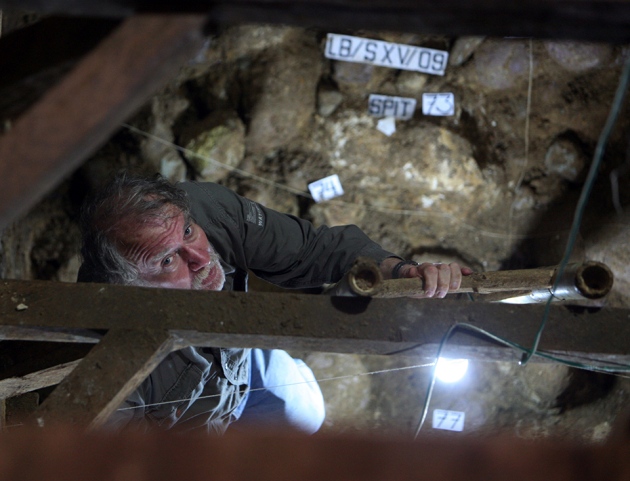
The late rock-art specialist Mike Morwood at Liang Bua cave, where his team discovered Homo floresiensis.
Seeking the hobbit’s ancestors, in 2004, Morwood’s team returned to a site 74 kilometres from Liang Bua called Mata Menge, where elephant bones and tools had been found in the 1960s. The dig started small, but in 2010 the team scaled up. Bulldozers cleared an area of 2,000 metres square, and more than 100 locals then dug for 6 days a week using chisels and hammers. They found hundreds of stone tools, thousands of fossils from animals such as crocodiles, rats and komodo dragons, but no hominin bones.

By then ill with advanced prostate cancer, Morwood visited the area for the last time in 2012. “He really made an effort to walk through the site, you could see he was in pain, but he was so detailed-minded,” van den Bergh says. “He increased the pressure to dig more holes and go faster. He really wanted to find them.”

Morwood, who died in 2013 before the teeth and jawbone were found, is an author on the Nature papers, which were co-led by scientists based in Japan, Australia and Indonesia.

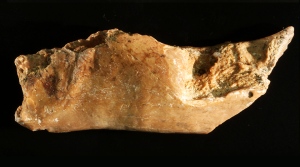
G. D. van den Bergh et al.The jaw bone found on Flores is from an adult who was even smaller than the hobbit.
The team concludes that the jaw excavated at Mata Menge is from an adult (its wisdom tooth had erupted) who was even smaller than the hobbit, and that two canines are the milk teeth of two different children. The thin jaw looks more like that of H. erectus and H. floresiensis than the beefier jaws of more primitive hominins such as H. habilis. The square-shaped teeth are intermediate between H. erectus and H. floresiensis. One tooth and the rock around it led the team to estimate that the remains are some 700,000 years old. The oldest artefacts in the region, meanwhile, suggest that a group of Homo erectus arrived on Flores about one million years ago, says van den Bergh.

Dwarfed by diet

He and his team note that the remains point to large-bodied H. erectus as the likeliest ancestor of the hobbit, and propose that it became dwarfed in just a few hundred thousand years to cope with the meagre resources on Flores. Elephants and other large creatures have been known to shrink over time to cope with the lack of food typical of islands, and red deer on the island of Jersey in the English Channel became one-sixth of their original size in just 6,000 years, says van den Bergh.

G. D. van den Bergh et al.Teeth found at the Mata Menge site

Both Fred Spoor, a palaeontologist at University College London, and palaeoanthropologist Chris Stringer at London’s Natural History Museum agree that H. erectus is now the best fit for the hobbit’s ancestor, although Stringer isn’t so sure that the shrinkage happened on Flores. It’s just as likely that the hobbit emerged on another island, such as Sulawesi, and then moved to Flores, he says.

But William Jungers, a palaeoanthropologist at Stony Brook University in New York, says that the fossils are not complete enough to favour the H. erectus origin: “I don’t believe these scrappy new dental specimens inform the competing hypotheses for the origin of the species one way or another.”

A small river that leads down a hill deposited the sandstone in which the teeth and jaw were found, and van den Bergh expects that more hominin remains lie there. His colleagues, meanwhile, have found stone tools in Sulawesi, north of Flores. For once, the prospect of more hobbits isn’t looking so bleak.

Nature 534, 164–165 (09 June 2016) doi:10.1038/534164a

Tomado de: http://www.nature.com/news/hobbit-relatives-found-after-ten-year-hunt-1.20045?WT.ec_id=NEWS-20160609&spMailingID=51569420&spUserID=NDE2OTkzMjMwMjMS1&spJobID=941259260&spReportId=OTQxMjU5MjYwS0

lunes, 27 de junio de 2016

Los chimpancés que jugaban con «muñecas» … de piedra

¿A qué niña no le gusta jugar con muñecas? ¿A qué niño no le gustan los Playmobil o las figuritas de superhéroes como Spiderman y Batman? Tanto en los días en los que Santa Claus o los Reyes Magos visitan los hogares humanos, como en cualquier aniversario o celebración que se precie, ambas preguntas tienen una clara respuesta. No es cuestión de género, pero no hay duda de que a los niños y niñas humanos les gustan los muñecos y las muñecas.

No obstante, pocos de nosotros nos paramos a pensar si este tipo de juego simbólico «tan humano» está ni siquiera presente en cualquier otra especie que no sea Homo sapiens. Pero la Primatología no deja de sorprendernos y el equipo del Prof. Richard Wrangham es uno de los responsables.

La primera ocasión fue el pasado 21 de diciembre de 2010. La prestigiosa revista Current Biology publicó la primera prueba documentada de juego con «muñecas/os» en chimpancés en libertad. Tal como comentan Richard Wrangham (Harvard University) y Sonya Kahlenberg (Bates College): «encontramos que los chimpancés juveniles tendían a llevar palos de una manera que sugería una muñeca rudimentaria, y que tal como sucede en animales cautivos y en niños, este comportamiento era más común en las hembras que en los machos».


Elementos de madera utilizados como «muñecas» el el artículo original de Current Biology 2010.


Chimpancé con bastón de madera. Fuente: Current Biology, 2010.

Lejos de ser una conclusión precipitada o puramente anecdótica, el estudio se basó en 14 años de trabajo de campo con 68 chimpancés. Eran unos resultados realmente sorprendentes, no tanto por «descubrir» algo que se desconocía —ya había sido un comportamiento documentado de manera anecdótica en chimpancés cautivos— sino por documentarla en libertad, con una amplia muestra de individuos y con unas claras diferencias entre sexos para esta conducta.

Pero el estudio prosiguió y el equipo de Harvard ha continuado proporcionándonos sorpresas. En un reciente vídeo publicado en la web de la BBC, Wrangham explica la manera en la que los jóvenes chimpancés de los bosques de Uganda «juegan» con piedras como si de muñecos y muñecas se tratase. Los jóvenes chimpancés las manipulan y transportan durante unos pocos minutos o incluso durante horas. Las llevan con ellos mientras comen y mientras trepan por los árboles y las ramas. Acarrean con ellas incluso en los nidos, donde llegan a dormir junto a sus «muñecas de piedra».

Desde el punto de vista de Wrangham «este tipo de comportamientos es difícilmente comprensible si no asumimos que los jóvenes chimpancés tratan a esas piedras como si fueran bebés». De la misma manera que ocurría en el trabajo original publicado en 2010 con las «muñecas de madera», las hembras juegan con las piedras entre 3 y 4 veces más que los machos. Estas hembras dejan de jugar con las piedras en el momento que tienen a su primer bebé.

Secuencia de chimpancé jugando con una piedra. Fuente: BBC

¿Es esta una nueva prueba de que la singularidad humana está en entredicho? Si bien puede ser un poco aventurado afirmarlo, sí que parece cierto que la «imaginación», el simbolismo y quizá la capacidad de abstracción a través del juego puede cumplir una función esencial en el desarrollo de habilidades fundamentales para la vida adulta como el hecho de ser madres y padres. ¿Significa además que las diferencias entre géneros tienen una base biológica y evolutiva? ¿Podemos seguir pensando que todas la diferencias de género han sido impuestas culturalmente? El debate está abierto.

Fuente: Citation: “Sex differences in chimpanzees’ use of sticks as play objects resemble those of children.” By Sonya M Kahlenberg and Richard W Wrangham. Current Biology, Vol. 20 Issue 24, Dec. 21, 2010.

Tomado de: http://www.investigacionyciencia.es/blogs/medicina-y-biologia/62/posts/los-chimpancs-que-jugaban-con-muecas-de-piedra-14175?utm_source=boletin&utm_medium=email&utm_campaign=Ciencias+sociales+-+Junio

lunes, 2 de mayo de 2016

Pieces of Homo naledi story continue to puzzle

Another twist in the Homo naledi tale

Age, place on hominid family tree, how fossils ended up in hard-to-reach cave remain unknown

DEEP EVOLUTION  Homo naledi fossils were found in South Africa’s Dinaledi Chamber, outlined here. Researchers debate whether this species dropped its dead through a shaft into the underground space, creating the array of bones shown on the chamber floor.
P.H.G.M. DIRKS ET AL/ELIFE 2015 (CC BY 4.0


Homo naledi, a rock star among fossil species in the human genus, has made an encore. Its return highlighted debate over whether this hominid was a distinct Homo species that purposefully disposed of at least some of its dead.

H. naledi made worldwide headlines last year when researchers announced the discovery of an unusually large collection of odd-looking Homo fossils in the bowels of a South African cave system. Presentations at the annual meeting of the American Association of Physical Anthropologists on April 16 underscored key uncertainties about the hominid.

One of the biggest mysteries: H. naledi’s age. Efforts are under way to date the fossils and sediment from which they were excavated with a variety of techniques, said paleoanthropologist John Hawks of the University of Wisconsin–Madison. An initial age estimate may come later this year if different dating techniques converge on a consistent figure. A solid date for the fossils is essential for deciphering their place in Homo evolution and how the bones came to rest in a nearly inaccessible cave.

Some presenters reasserted that H. naledi intentionally dropped dead comrades into an underground chamber, where their bones were later found by cave explorers and then scientists. But others raised questions. Even paleoanthropologist and team leader Lee Berger of the University of the Witwatersrand in Johannesburg hedged his bets.

“It’s way too early to tell how H. naledi bodies got in the chamber,” Berger said.

Berger’s group recovered 1,550 H. naledi fossils from a minimum of 15 individuals of all age groups (SN: 10/3/15, p. 6). Slender researchers wended through narrow passageways in South Africa’s Rising Star cave system and squeezed down a vertical chute to reach pitch-dark Dinaledi Chamber. There, they found hominid fossils scattered on the floor and in a shallow, 20-centimeter-deep excavation.

Berger’s team assigned the bones to H. naledi based on an unexpected mix of humanlike features and traits typical of Australopithecus species from more than 3 million years ago.

Fossil analyses presented at the meeting challenged a suggestion by some researchers, both before and during the meeting, that H. naledi actually represents a variant of Homo erectus, a species known to have existed by 1.8 million years ago (SN: 11/16/13, p. 6).

H. naledi possessed a shoulder unlike those of other Homo species, said team member Elen Feuerriegel of the Australian National University in Canberra. The Rising Star hominid’s collarbone and upper arm bone resemble corresponding Australopithecus bones, she reported. H. naledi’s shoulder blades must have been positioned low and behind the chest, an arrangement more conducive to climbing trees than running long distances.

H. naledi’s hand was built both for climbing and gripping stone implements, said Tracy Kivell of the University of Kent in England. Her analysis of 150 hand bones, including a nearly complete hand, showed a humanlike wrist and thumb combined with Australopithecus-like curved fingers.

MIXED GRIP H. naledi’s hand combines a humanlike wrist and thumb with curved fingers characteristic of tree-climbing hominids. This unusual hand design sets H. naledi apart from other Homo species, researchers argue.
L.R. BERGER ET AL/ELIFE 2015 (CC BY 4.0)


H. naledi’s curved toes and flaring pelvis also recall Australopithecus. Still, a preliminary lower-body reconstruction — incorporating fossil evidence of humanlike legs, knees and feet — suggests H. naledi walked almost as well as modern humans do, said Zach Throckmorton of Lincoln Memorial University in Harrogate, Tenn.

West Asian H. erectus and H. naledi share several tooth features as well as relatively small braincases. In addition, adult H. naledi stood an estimated 147 centimeters tall (4 feet, 10 inches), within the height range for West Asian H. erectus. “That complicates matters,” said Christopher Walker of Duke University. Upper-body features that Berger’s team considers characteristic of H. naledi, such as the upper arm’s shape, possibly occurred in West Asian H. erectus as well, added Witwatersrand’s Tea Jashashvili, who has studied those finds.

Explaining how H. naledi bones ended up in Dinaledi Chamber is also complicated. Ongoing studies of sediment and rock indicate that there was never a direct opening to the underground fossil site from above, said Witwatersrand’s Marina Elliott.

Bones from some body parts, including five feet, three hands and part of a backbone, were found aligned as they would have been in living individuals, indicating at least some bodies reached the chamber intact, Hawks said. Curiously, some sets of aligned bones were found beneath scattered bones from diverse individuals.

If the dead were dropped down a vertical chute into Dinaledi Chamber, bodies on top would have been least damaged and most likely to retain aligned bones. Along with that mystery, some sets of aligned bones somehow ended up far from the chute’s opening, Berger said.

An alternative entrance to Dinaledi Chamber possibly existed in the past, Witwatersrand’s Aurore Val  asserted online March 31 in the Journal of Human Evolution. Beetles or snails that damaged some H. naledi bones don’t inhabit dark, underground caves, Val argues. Such damage probably occurred on the surface or in a nearby, once-accessible part of the cave system, she proposes.

The surfaces of many H. naledi fossils had been worn down enough to have possibly erased predators’ tooth marks and signs of animal trampling, which would be additional signs that another entrance to the chamber once existed, Val says.

Given the large number of isolated and broken H. naledi fossils, bodies or body parts may have entered the chamber long after death, in Val’s view. Perhaps water from another part of the cave system carried bodies into Dinaledi Chamber, she speculates.

Geologic studies show that water occasionally reached the chamber and mildly eroded sediment, Berger said. But he doubts water washed bones into Dinaledi Chamber. “Even if there was another entrance to the chamber, it still allowed access only to Homo naledi,” Berger argued. No remains of any other animals have been found in the cave.

Like any rock star of lasting impact, the South African hominid plans to wow fans with new material. “Thousands of Homo naledi fossils are almost certainly left in the underground chamber,” Berger said.

Editor’s note: This story was updated April 25, 2016, to correct the identification of organisms that have damaged some H. naledi bones.


Tomado de: https://www.sciencenews.org/article/pieces-homo-naledi-story-continue-puzzle